
Our projects
Developing innovations, making history accessible, embracing change: learn more about the projects that are improving our offering and making the ZB even better.
Preserving what works while exploring new avenues: that philosophy applies not just to our media offering but also to our services, our infrastructure and, not least, our own organisation. Our projects are helping us to provide a state-of-the-art service underpinned by a modern infrastructure. Projects are thus an important part of our work, and one for which we have an annual budget to invest. Below you will find selected projects from one of the following fields:
New products – Digitisation Projects – The ZB continues to develop – Technology, construction and logistics
If you have any questions or would like to share your views on our project portfolio, contact:
New products
New offerings and services open up access to our holdings and help the ZB to become an even better place to learn and obtain information – both virtually and in person.
Digital Text Production
The digitised copies of our manuscripts and printed works are no longer sufficient for researchers and scientists. They also need the image content, i.e. the text, in digital form. That is why we want to set up a new Digital Text Production research service and develop a process that can be used to extract digital text from digital images using automated methods. We will add markup to this text according to TEI standards and make it freely available online.
Process development is being carried out in two sub-projects based on pilot holdings: ‘Digital edition of the correspondence of Hans Georg and Hermann Nägeli’ and ‘Jeanne Hersch: digital reprint of writings’. The processed digital images from both sub-projects will be made available at sources-online.org.
Sub-project 1: Digital edition of the correspondence of Hans Georg and Hermann Nägeli

To the sub-project 1 website
Sub-project 2: Jeanne Hersch: digital reprint of writings

To the sub-projekt 2 website
If you have questions or would like to share your views, contact:
Development of research services for digital editions at the ZB
The aim of this project is to bundle and coordinate previous activities of the ZB in the field of digital publishing and to focus on the development of research services. This is primarily a question of taking the experiences we have gained in the two Digital Text Production sub-projects (see above) and conceptualising them as research services. They should be able to be used by researchers as services for further digital publishing projects. In this way, the ZB meets the wishes and needs of the research community and contributes to the development of research infrastructures. As a research partner, the ZB is supporting science in general and digital publishing in particular in an effective and innovative way.
Specifically, the aim is to expand the ZB’s range of services from image scanning with OCR to layout recognition, segmentation, NER/NEL, standard data linking and text markup according to TEI standards. The aim of metadata creation is to collect publication-specific metadata and create and edit standard data. However, consideration should also be given to other services in the area of digital editions.
If you have questions or would like to share your views, contact:
Making the Wille family archive accessible for research
Since the early 19th century, the Wille family of Zurich had maintained contacts with important figures in politics, business, the military, and culture throughout Europe. In 2021, the family handed over its significant private archive to the Zurich Central Library on condition that it be catalogued in its archive information system and made searchable in ZBcollections by the 100th anniversary of the death of Ulrich Wille, Switzerland's commander-in-chief during World War I. Since February 1, 2025, the documents in the Wille family archive have been available to researchers and the interested public in the Special Collections reading room without any restrictions.
In order to protect the fragile originals and to further facilitate their use, the ZB is digitizing a selection of frequently used and particularly significant documents and publishing them online on the national platform for digitized manuscripts from Swiss libraries and archives, e-manuscripta.ch.
The project is financially supported by the Oscar Fritschi Stiftung, the “Donation Prof. Dr. Maria Bindschedler”, Baugarten Zürich, the Fondation Claude et Giuliana, the UBS Culture Foundation and the Fondation Pierre du Bois pour l’histoire du temps présent.
GoogleBooks DATIF – data, text, infrastructure for research
Data is fuel: In the digitization project with “Google Books”, large amounts of data were generated from the digitized material linked in Swisscovery. We exploit the potential of these full texts and images together with their metadata and make them usable by offering them as open cultural data through new services and shared platforms for research and teaching.
This data project is designed as a cooperative venture under the title “Books as Data – Swiss Google Books for Research”. We publish full-text documents and digitized material – a total of over 140 million pages – with a focus on transparency, corpus building, and interoperability. It was important to involve researchers in order to tailor our offerings to actual needs. Together with our partners at the Basel University Library, Bern University Library and Lucerne University Library we developed a platform, which we have continuously refined in terms of design and functionality, that presents this large digital text corpus as a whole and makes it available for research and teaching: https://www.books-as-data.ch
Following the go-live of the initial version in September 2026, work continues: We are transitioning the platform into stable, collaborative organizational and funding structures. And we are optimizing its functionalities, in part based on systematic feedback from researchers. New methods for analyzing, processing, and enriching the data are being tested and implemented to make the collection as accessible as possible. The project is an integral part of the existing Swiss portal landscape for retro-digitized historical collections and expands it, in particular, through the sheer volume of accessible works. “Books as Data – Swiss Google Books for Research” is therefore another step toward a digitally accessible corpus of a representative selection of all old prints from Swiss libraries and actively accepts its role as a reference tool.
Contact:
St. Gallen globe online
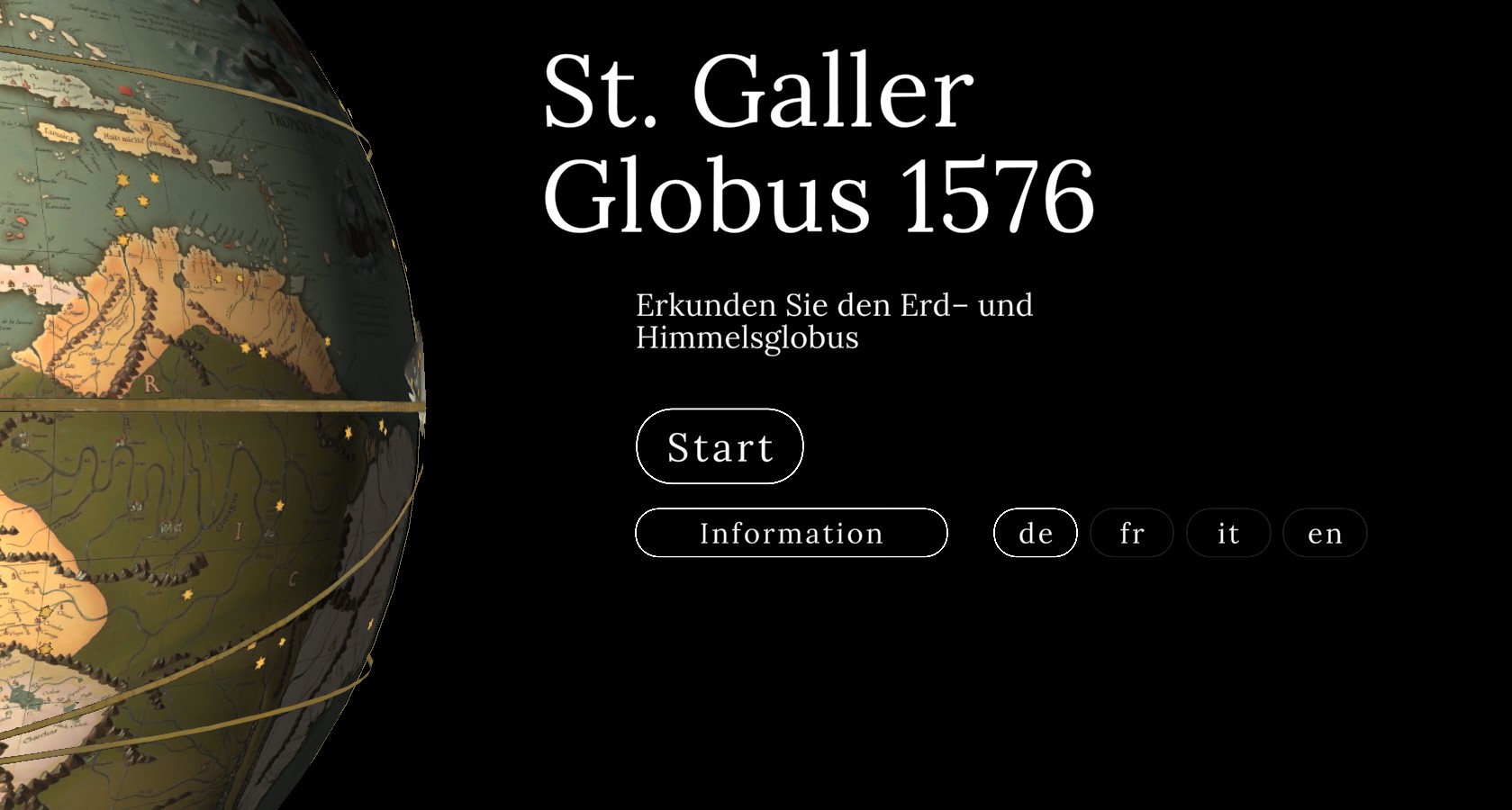
As a combined terrestrial and celestial globe, the famous St. Gallen globe from 1576 provides insights into the history of globalisation and the cosmology of its time. In the initial phase of this cooperation project, we developed the basic model of an online globe so people could explore the globe at any time and from anywhere in the world. Based on this, we are planning a range of activities in cooperation with academic institutions and the public in the context of the project.
Project partners: Swiss National Museum, Abbey Library of Saint Gall, Zurich University of the Arts, ETH Zurich Institute of Cartography and Geoinformation, University of Zurich Center for Historical Mediology
In order to make the globe even more accessible, a smaller model was built. This model is on display in the reading room of the ZB. It allows visitors to experience the full functionality and iconographic imagery of the globe and its frame. It thus complements the online version and the original globe exhibited at the Landesmuseum.
If you have questions or would like to share your views, contact:
Clean data thanks to Theseus
We are cleaning up our catalog: The digital data from the ZB that you find in Swisscovery today was created at different times in different library systems according to different sets of rules. A considerable portion of the data dates back to when the decades-old card catalog was digitized in the “Medea” project. This data, some of which is incomplete or incorrect, is being comprehensively cleaned in the “Theseus” project (2025 to 2027 initially, expected to continue until 2030): specialists in old prints are completely revising title data so that it can be used as research data. Once processed, titles and copies from the modern collection can be searched and ordered without restriction. We are making these improvements on an ongoing basis so that your searches will become increasingly efficient and reliable.
If you have questions or would like to share your views, contact:
Digitisation projects
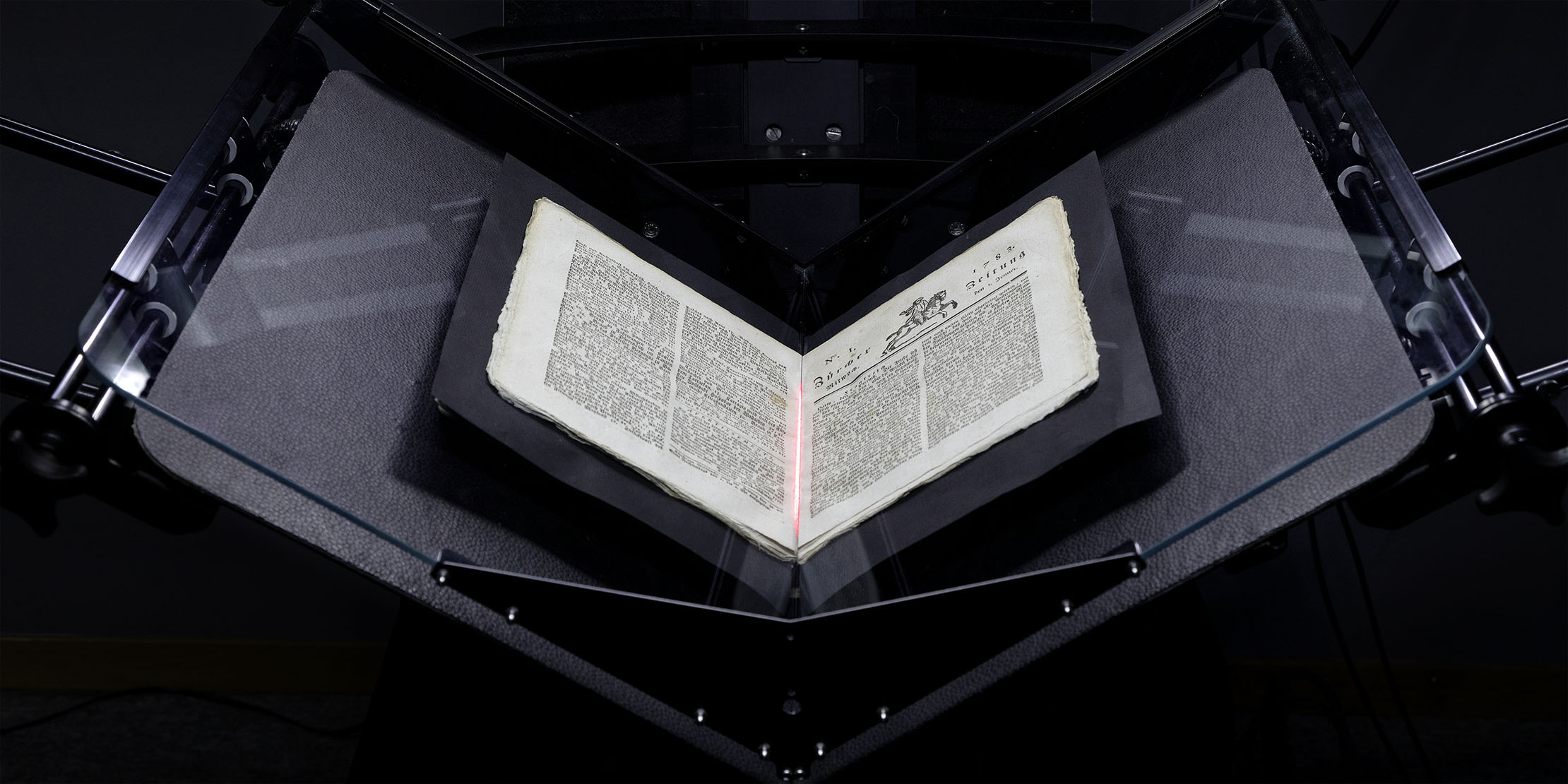
The Zurich cultural heritage from our collections is invaluable to both researchers and the general public. We are running a wide range of digitisation projects, often on a cooperative basis, to create high-quality digital versions of our holdings and compile the associated metadata to make them available online and usable for research.
Numerous digitisation and research projects from recent years have now been completed. We are currently developing new research services in the field of digital text production and digital editions.
On the ‘Digitisation and Research’ page, you can learn more about our services in this area.
If you have questions or would like to share your views, contact:
Digitisation of four Zurich newspapers
As a follow-up project to the retrodigitisation of the NZZ, the ZB will digitise four additional Zurich newspapers by the end of the year in cooperation with their respective publishers and the Swiss National Library. The periodicals will then be published free of charge on the newspaper platform e-newspaperarchives.ch. This means that in addition to the NZZ, we will be making even more important Zurich newspapers available online with searchable wording. The following years will be digitised:
- Tages-Anzeiger 1893−1959
- Der Landbote 1836−1950
- Zürcher Oberländer 1853−1970
- Anzeiger von Uster 1846−1954
A total of around one million newspaper pages are being processed by external service providers.
The digitisation of Zurich newspapers is supported by the Lottery Fund of the Canton of Zurich.

If you have questions or would like to share your views, contact:
The ZB continues to develop
Change and new challenges require cooperation, new ways of working and new competencies. Our projects are therefore a place for us to develop as employees, as an organisation, and as a partner for collaborations.
Involvement in the “Aufbau Universitätsbibliothek Zürich” (AUB) project
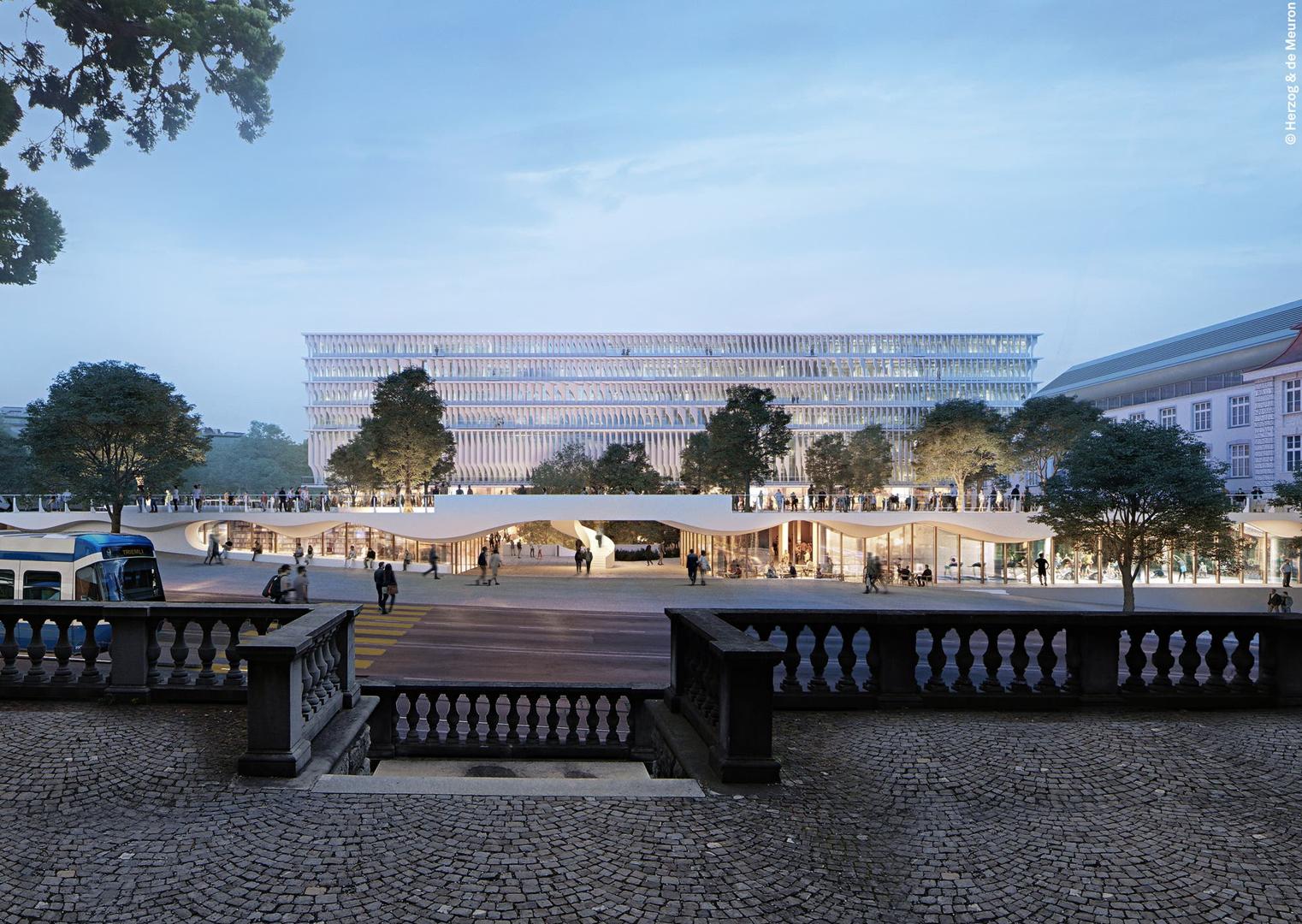
The University Library Development Project (AUB) is an initiative of the University of Zurich, carried out in close cooperation with the Zentralbibliothek Zürich. As the key partner of University Library Zurich, the Zentralbibliothek is involved in various work packages within the project. Our common goal is to create a powerful and effective partnership for research, teaching, and study at the University of Zurich (UZH). This partnership is characterized by efficiency and innovation and offers our customers outstanding services from a single source.
In the first phase of the project (2017-2021), the foundations were laid for the establishment of the University Library Zurich, which began operations on January 1, 2022. The second phase (2022–2023) served to consolidate the cooperation between the University Library and the Zentralbibliothek. A significant result of this phase was the joint strategy of the University Library and the Zentralbibliothek for 2024–2027, which marks a new high point in our cooperation.
In the ongoing third phase (2024–2027), a particular focus is put on the joint implementation of this strategy. Other priorities in this phase include the development of a joint website, the expansion of cooperation to include special collections and holdings, and the development of a joint archiving concept for printed holdings.
You can find the website for the main project here.
If you have questions or would like to share your views, contact:
Technology, construction and logistics
Modern technology, logistics and buildings are the basis for a modern, efficient service offering from the ZB.
Renovation of the old building
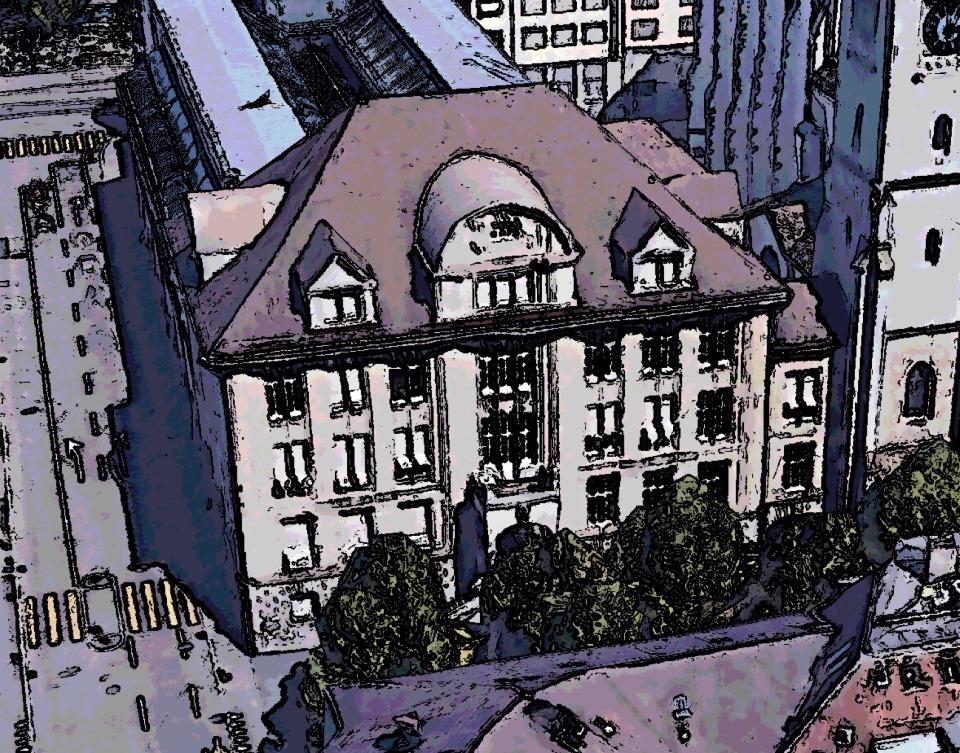
Our old building was partially renovated in 1983 and a number of individual measures have been carried out since then. But improvements are needed, for example to remedy problems with the indoor climate affecting the cultural heritage and replace outdated electricity and IT infrastructure.
We are therefore developing a sustainable building strategy for the old building to serve as the basis for a comprehensive renovation. We aim to put in place an infrastructure that provides the best possible working environment for both users and ZB staff, and creates optimum storage conditions for protecting our historical holdings. Building work is scheduled to begin at the end of 2021, and the renovation is intended to satisfy requirements for the next 25–30 years.
If you have questions about the project, contact:
Completed Projects (selection)
Here you will find a selection of our completed projects. The most recent projects are listed at the top. If you have any questions reagarding our completed projects, please contact: Verena Klein
Cooperation with Google Books
Together with the University Libraries of Basel and Bern and the Central and University Library of Lucerne, the ZB has digitised historical prints from 1500 to 1900, with a focus on the period from 1700 to 1900. The digitisation was carried out by Google and the works are available free of charge on the platform Google Books. Since October 2025, around 160,000 digitised titles from the ZB have been available. They can be accessed directly via Google Books links in the corresponding books at swisscovery.
Digital edition of the correspondence of Johann Caspar Lavater
The ZB owns more than 20,000 letters written by and sent to Lavater (1741–1801), the renowned Zurich theologian of the eighteenth century. For the online edition of his correspondence (lavater.com), we have created around 110,000 digital copies and compiled the associated metadata between 2018 and 2024. The SNF funded a 50% position at the ZB for the duration of the project. The edition is based at the German Department of the University of Zurich.
Conrad Ferdinand Meyer’s correspondence with his publisher in digital form
Conrad Ferdinand Meyer’s (1825−1898) correspondence provides a wide range of insights into the development of Meyer’s important literary works and into his private life. The previously printed edition of letters, ‘C.F. Meyers Briefwechsel. Historisch-kritische Ausgabe (MBW)’ (C.F. Meyer’s Correspondence. Historical-Critical Edition), has been converted into an online edition. In this context, from 2019 to 2024, we digitised letters and other documents from Meyer’s estate, which is stored at the ZB. The SNSF-funded publication project of the German Seminar at the University of Zurich (cfmeyer-briefwechsel.org) has imported around 16,000 digitised copies from the ZB into its database.
The Physiognomic Cabinet of Johann Caspar Lavater
The busy Zurich pastor Lavater (1741−1801) became known throughout Europe for his considerations of physiognomics. The Physiognomic Cabinet, which was largely unknown to date, was both the basis and the result of his reflections. The ZB owns 1800 images of this collection, which we have indexed and digitised from 2019 to 2021. The UBS Culture Foundation financially supported the one-year project. The entire cabinet can be viewed here.
Citizen Science
As a place of public culture and education, we made it one of our strategic goals from 2021 to 2024 to support and carry out citizen science projects. This field of activity was established as part of a project and has been an integral part of our services since 2025. On this page, you can find out which citizen science projects you can participate in to make your knowledge available to the public and contribute to research.
Development of systematic customer research and customer experience
To make sure our services and products offer our customers added value and a positive and intuitive experience, we developed structures and processes for systematic customer research and CX management in our library.
Connecting Itten. Sub-Project 2: Linked-Open-Data Knowledge Platform
The ZB holds the literary estate of the Swiss artist, art theoretician and teacher, Johannes Itten (1888-1967), which has been fully catalogued and is available via ZBcollections.
In a second project phase, the Johannes Itten Linked Archive (JILA) was developed, which is based on linked semantic data (Linked Open Data) from the Itten Archive. You can find more information about the project and our project partners here.
Developing ZB-Lab
The ZB Lab is an experimental space for making creative use of our diverse data. We actively use the Lab for research concerns, for Citizen Science projects and for our own developments to improve the usability of our data.
You can find the website for the main project here.
ZB-SharePoint: launching a collaboration platform
In this project, we launched a collaboration platform with Microsoft Office 365. Our aim was to link some 240 members of staff together and make it easier for them to work together both within and across departments. But there was more to the project than technology: we reorganised our knowledge and information flow, and created a central location to work together flexibly and virtually.
Retrodigitisation of the NZZ (1780−2020)
In cooperation with the Neue Zürcher Zeitung (NZZ) and the Swiss National Library (NL), we digitised all volumes of the NZZ published up to 2020 between 2019 and 2023. In total, more than two million newspaper pages were scanned. They are freely accessible and searchable in full text on the online newspaper platform e-newspaperarchives.ch, subject to a 25-year moving wall. This major digitisation project received financial support from the Lottery Fund of the Canton of Zurich and the UBS Culture Foundation.

Repository for e-Turicensia
As a cantonal library we collect Turicensia: publications on topics related to Zurich, by Zurich authors, or that are printed in Zurich. As throughout the publishing world, they are increasingly appearing in digital format. During this project, we developed the repository «Zurich Open Platform (ZOP)» to preserve the digital publications from our collection long-term, present them and make them accessible to the public.
CAS in Data Management and Information Technologies
A grounding in IT and experience in handling data are becoming indispensable to many library functions. We therefore created a new CAS course in Data Management and Information Technologies. Further information about the CAS course can be found here.
DigiTUR (2013−2018): more than five million scans produced
From 2013 to 2018, the ZB carried out its own digitisation project during which we indexed and made available online representative groups of the Zurich cultural assets from our holdings. Thanks to the funding of the lottery fund of the canton of Zurich and the city of Zurich with a total of approximately CHF 10 million, we produced over five million scans, which are available on national platforms (e-rara.ch, e-manuscripta.ch, e-newspaperarchives.ch and e-periodica.ch). We retro-digitised 4.5 million pages of old prints, 400,000 pages of historical Zurich newspapers, around 100,000 pages of handwritten materials and music each, 50,000 graphic sheets and photographs and around 2,500 maps and panoramas. More than 20 specialists from all departments participated on the project. A short YouTube video by Lorenz von Meiss documented the project in 2017. Our DigiTUR project still is one of the largest digitisation projects carried out by a Swiss library to date.
We would like to thank the following institution for its funding: