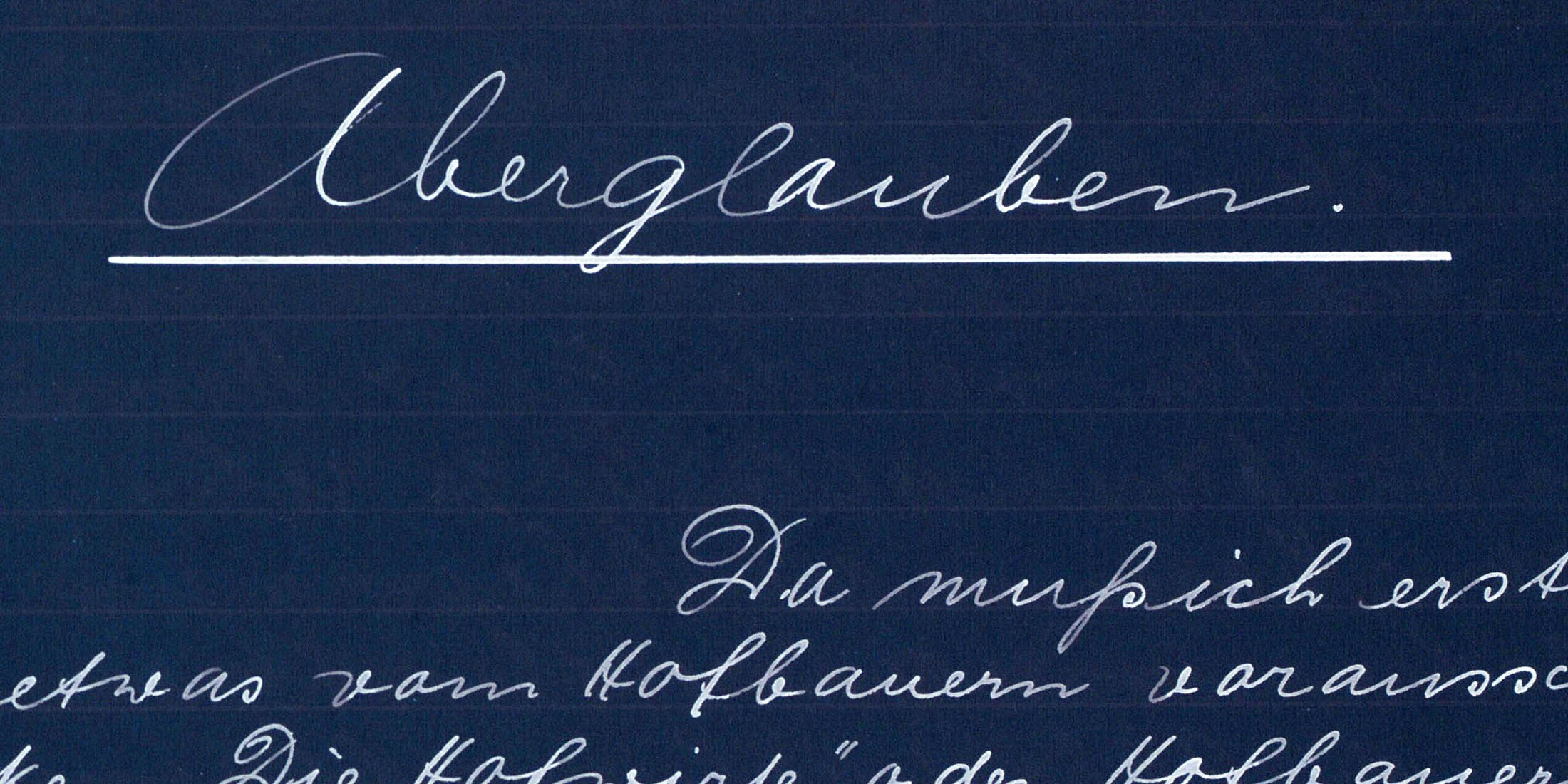
Superstition in the canton of Zurich
Revenants, omens and healing coffin nails – Zurich’s community chronicles tell of a world that was still enchanted in the 19th and early 20th centuries.
Superstition in enlightened times

It’s always other people who are superstitious. Especially people from the past. We only allow ourselves to be superstitious in small ways and with a wink. But to renounce superstitions completely? We’d rather not – better to be safe than sorry, plus the lucky charms and crossed fingers can’t do any harm.
As a cultural technique, superstition is a way of coping with the world that is not based on scientific knowledge or the beliefs of recognised religions. It offers guidance and steps into the breach when nothing else helps, making us feel a little less powerless.
Since the Enlightenment, the world has been demystified and uncritical superstition has become a thing of the past. Or so you’d think. Various publications actually tell a different story. For example the Zurich community chronicles, whose authors report on superstition in the canton of Zurich in the 19th and early 20th centuries.
‘This superstition isn’t dead, as one might think; it is merely buried under educated opinions, but underneath it is still very much alive and manifests itself in deeds.’
Meilen community chronicle from 1918
Supernatural figures

In the 1860s, a suicide victim began to haunt this bridge between Andelfingen and Kleinandelfingen. (Image: Andelfingen community chronicle from 1917 / ZB Zürich)

Anyone who crosses the bridge at night risks being harassed and followed by this revenant. The schoolchildren of Kleinandelfingen no longer dare to go near the bridge after sunset. (Image: Andelfingen community chronicle from 1917 / ZB Zürich)

The chronicler of Andelfingen writes about the undead suicide victim in the community chronicle from 1918. (Image: ZB Zürich)

At night in the forest, a pedestrian plagued by a guilty conscience believes that the unsuspecting chronicler of Andelfingen is the devil who has come to take him away. ‘Black is the devil, black is the night […]’ is written under Gottfried Keller’s ‘Teufelpfaff’ (Devil’s Cleric), from around 1845. (Image: ZB Zürich)

In the 19th and 20th centuries, witches were no longer executed in Zurich. Individual suspicions still persisted, however. (Image: Johann Heinrich Füssli / ZB Zürich)

On a farm in Glattfelden, the deceased farmer haunts his house and barn. The revenant even haunts the farmhand’s donkey, braiding its mane at night. (Image: Glattfelden community chronicle from 1918 / ZB Zürich)

One chronicler suspects that superstition is rare in his municipality because of its proximity to the city. Nevertheless, the residents of Fällanden speak of ‘Zeusler’ (fire ghosts). (Image: Fällanden community chronicle from 1902 / ZB Zürich)
All kinds of supernatural creatures roamed the canton of Zurich back then: various ghosts, the devil himself and people with magical abilities.
In Glattfelden, for example, a farmer and a farmhand cast spells on each other, causing one’s scythe to cut less effectively and the other’s cart to break down. In Rafz, women were still occasionally suspected of witchcraft whenever a child fell ill or an accident occurred in the stable. And in Brütten, Beelzebub left ‘devil’s dung’ here and there in the stables.
However, other figures from the world of superstition played a more important role in the Zurich community chronicles: the dead who are unable to rest in peace. These revenants still roamed because they committed suicide or an injustice, and they would terrify people – and, in Glattfelden, even a donkey. Some haunted houses and stables, while others roamed through fields and woods as ‘fürige Mannen’ (fiery men), ‘brünnige Mannen’ (burning men/will-o'-the-wisps) or ‘Zeusler’ (fire ghosts).
‘The people say: they are ‘Zeusler’, i.e. ghosts of the dead who committed some kind of crime in that place during their lifetime, e.g. they peddled myths, stole land, damaged trees, etc. As punishment for their misdeeds, they must reappear in fire at the place in question.’
Fällanden community chronicle from 1902
Protecting home and farm

Idyllic by day, quickly scary by night: a farm on the edge of the forest, probably on the Adlisberg, 1917. Would we all be a little more superstitious if we were on a remote farm at night? (Image: Alfred L. / ZB Zürich)

The chronicler of Brütten describes how farms are protected from ‘Ungfell’ (misfortune) using magic spells. He witnessed this superstitious protective measure on the ‘Birchhof’ farm. (Image: Brütten community chronicle from 1903/04 / ZB Zürich)

This survey map shows how remote the ‘Birchhof’ farm is: the village of Brütten is the pink shaded area in the middle with the church. (Image: Brütten community chronicle from 1902 / ZB Zürich)

The village of Brütten around 1921, surrounded by fields and woods. (Image: Brütten community chronicle from 1921 / ZB Zürich)
People found various ways and means to get rid of supernatural beings. Many trusted in the magical power of Capuchin monks, who would, for example, nail an evil spirit to a wall or ‘banish’ an undead suicide victim to the pond in which they drowned themselves.
To prevent this from becoming necessary in the first place, the people of Zurich took various measures to keep ‘Ungfell’ (misfortune) away from their homes and farms. Some got black cats or black goats, while others placed a broom at their door so that they could defend themselves if necessary. In the second half of the 19th century, a live toad was walled into a stable in Meilen to ward off misfortune.
Another strategy was more elaborate. At the remote ‘Birchhof’ farm near Brütten, small, plugged holes were found in the beams of the stable at the turn of the century. Inside were magic spells written on pieces of paper. Historian Emil Stauber encountered the same thing back in the 1920s in the municipality of Stadel in the Zurich Unterland.
Sickness and death – medical superstitions and omens

The untimely chime of a bell, a bird of misfortune: Zurich's superstitions include many omens. A picture from the Meilen community chronicle from 1918, above which flies a raven by Johann Meyer from 1703. (Image: ZB Zürich)

In Russikon, a villager describes a healing ritual for his wounded son. The chronicler gives a verbatim account. (Image: Russikon community chronicle from 1917 / ZB Zürich)

New buildings claim their victims: the chronicler of Mettmenstetten tells of the belief that a family member must die in the year after a house is built. (Image: Mettmenstetten community chronicle from 1905 / ZB Zürich)
It wasn‘t just supernatural beings that the people of Zurich feared in the 19th and early 20th centuries. Sickness, suffering and death were also high on the list of frightening things.
At a time when the rural population in particular often helped and had to help themselves with health problems, medical superstition played an important role. In search of a cure, or at the very least relief, people carried around ‘Sympathiemittel’ (folk remedies) such as teeth and coffin nails, which were believed to help with toothache or earache.
Medical superstition includes countless other means and practices. A report from the Zurich Oberland shows how imaginative and elaborate some of them were:
‘My little boy had a ‘Brüchli’ (broken bone). First, I cut off the nails on his right hand and left foot, then on his left hand and right foot – crosswise! – I collected the cut pieces and put them in a goose quill, went out at midnight and found a tree, and I drilled the quill into it while invoking the three highest names. It was a slow process, but according to the instructions, I was finished before sunrise […].’
Russikon community chronicle from 1917
In the world of superstition, death rarely goes unnoticed: omens herald it. Pale plants in the garden, gaps in the funeral procession, the striking of the hour coinciding with the ringing of funeral bells, ravens flying around a house cawing – the harbingers of death are manifold. They take away some of its unpredictability.
Superstition throughout the year

In addition to omens, special calendar days also provide clues about the future. On certain days, it is also possible to positively influence fate in one way or another. We are still familiar with astrologically significant things such as the lunar calendar and the signs of the zodiac, but other calendar superstitions have fallen into oblivion.
The Zurich community chroniclers report on various days that are associated with a particular superstition, some even with several.
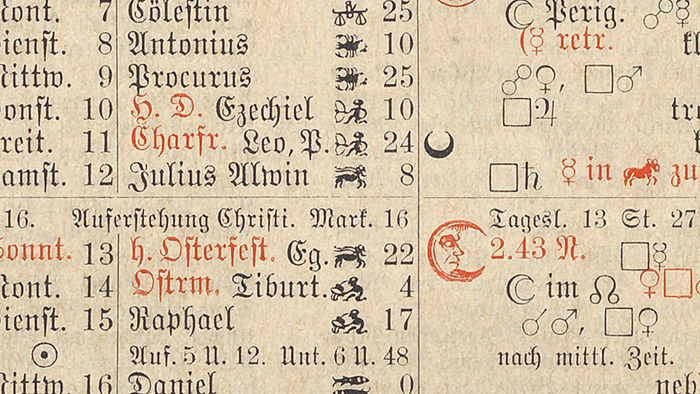
Good Friday
The community chronicles contain a great deal of superstition with regard to Good Friday:
- Water fetched from the well on Good Friday morning while the church bells strike 9 o’clock helps against everything.
- Vinegar drawn from the vinegar mother on Good Friday keeps best.
- A ring forged from seven used coffin nails on Good Friday between midnight and 1 a.m. and worn on the finger protects against and helps cure serious diseases.
Eggs laid on Good Friday are said to have several special properties. Good Friday eggs…
- … cure all diseases.
- … don’t spoil.
- … cannot be dyed.
- ... protect buildings against lightning strikes and fires.

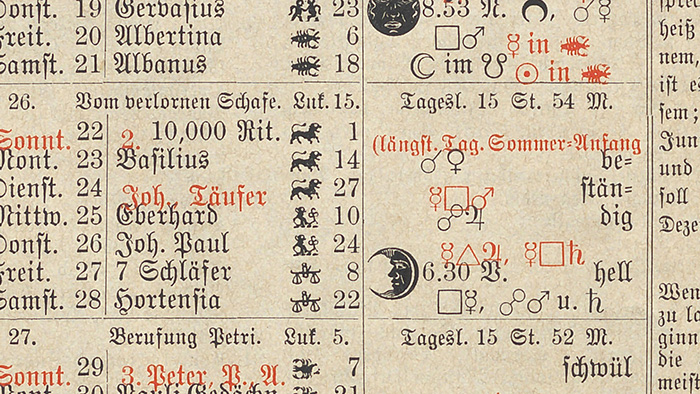
10,000 Martyrs’ Day
The Day of the 10,000 Martyrs on 22 June is dedicated to the 10,000 Christian martyrs who, according to legend, were crucified on Mount Ararat under the Roman emperor Hadrian in the 2nd century. Because ‘someone must drown in the lake on this day’, swimming is discouraged in Meilen.

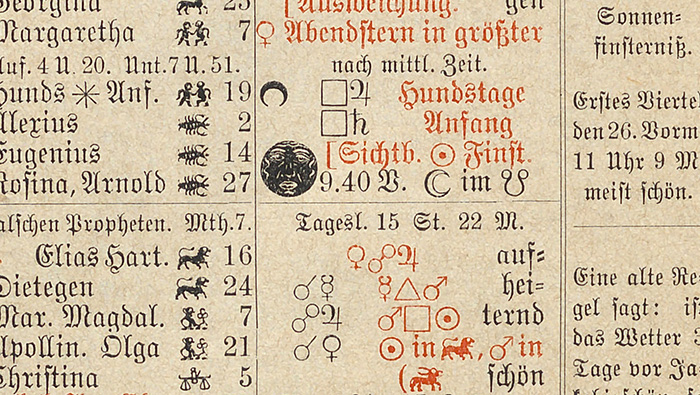
Dog days
During the dog days from 23 July to 23 August, illnesses are incurable. If the weather is good during these summer days, the year will be a good one, either in general or in terms of health. Bad weather, on the other hand, means that bad times are ahead.
Even in the summer heat of the dog days, swimming is not recommended for fear of illness.

St Andrew’s Day
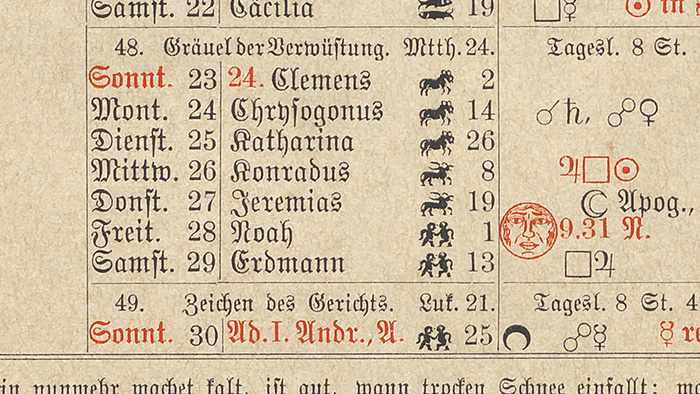
On the night of 30 November to 1 December, young women can find out who their future partner or at least their next suitor will be in various ways:
- Lie down backwards in bed or secretly mop the living room backwards at midnight: your future partner will appear in a dream.
- At midnight, mop the living room backwards and also take out the rubbish backwards: when you come in, your future partner will appear sitting at the table.
- Peer into the well at midnight: the face of your next admirer will appear.

Christmas
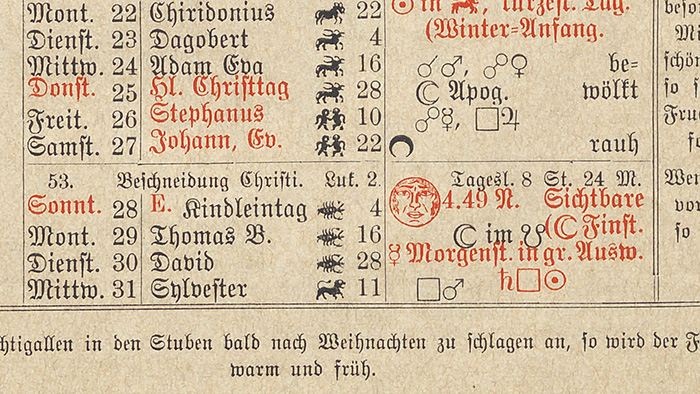
Around Christmas, farmers have a particularly good chance of influencing their fate:
- Those who tie willow straw around the trunks of their fruit trees at 4 p.m. on the Saturday before Christmas will harvest a particularly large amount of fruit the following year. Some people also consider New Year’s Eve to be the right time.
- Those who let their cattle drink at midnight on Christmas Eve will have ‘blessings in the barn all year round’ in Schöfflisdorf.
- Whoever is the first to let their cattle drink at the communal well on Christmas morning will have the most beautiful cows or simply good luck in the barn the following year.
If you want to hear your cattle speak, you can do so on the last day before Christmas: at midnight, ‘the cattle talk to each other’, according to the chronicler from Brütten.
Children born around Christmas are also said to have the ability to see supernatural things.

‘Lostage’
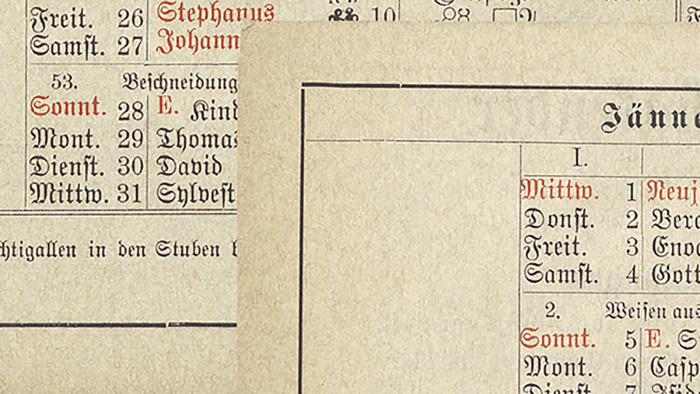
Many people use the last six days of the year and the first six days of the new year as so-called ‘Lostage’ (days of fate), calendrical lore used to predict the weather for the coming year. The weather on 26 December predicts the weather in January. The same applies to 27 December and February, 28 December and March, and so on through to 6 January and the month of December.
The observations made during the ‘Lostage’ are recorded as a weather forecast for the coming year, as shown in the picture for the municipality of Wald: crosshatching = rain, dots = snow, empty = bright (i.e. not cloudy, clear), shaded = cloudy. The first two circles show the morning and afternoon weather, while the third circle shows four time windows: morning – 9 a.m., 9 a.m. – 12 p.m., 12 p.m. – 4 p.m., 4 p.m. – night.

New Year’s Eve and New Year’s Day
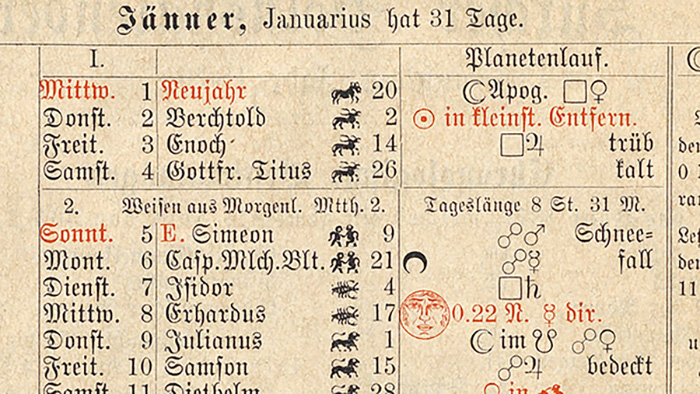
On New Year’s Eve, farmers in Rafz can positively influence their next year by ‘helping the trees’: if they bind straw or a ‘willow sheaf’ around their trees between the ringing of the bells from 11 to 11:30 and the ringing from 12 to 12:30, they will bear plenty of fruit the following year. In other places, the trees are wrapped before Christmas.
On New Year’s Day, it is important that the men wish the women a Happy New Year before the women do so. In Wald, it’s best for three men to offer their ‘congratulations’ before a woman does so. If a woman makes the first move, it’s bad luck. And anyone who sweeps the living room on New Year’s Day sweeps away good fortune.

Superstition today

The examples of the practised superstitions described here are only a small glimpse into the enchanted world of the community chronicles. The chronicles, in turn, only document part of the superstitious world they describe. The authors are predominantly clergymen, some also teachers – the educated men of the respective parish. What would farmers’ wives and innkeepers have said about superstition in the canton of Zurich?
Either way, the world back then is no longer ours. From today’s perspective, superstitious rules, actions and predictions may seem somewhat naive, but this view does not do them justice. As a cultural technique that enables people to act in difficult situations, superstitions are actually quite clever.
Where do we stand today with regard to superstition? There are no official figures for the canton of Zurich – no wonder, as superstition is difficult to measure. However, there is no doubt that it still exists. Horoscopes, manifesting, crossing fingers, dream catchers, the power of crystals – superstition haunts the lives of our pluralistic society in many forms.
Read more
- ‘Aberglaube und Sagen im Kanton Zürich’ (Superstition and myth in the canton of Zurich) by Emil Stauber: a historical report
- The Zurich community chronicles: all available in our physical holdings and some in digital form on the Zurich Open Platform (ZOP)
- ‘Die Gemeindechroniken des Kantons Zürich’ (The community chronicles of the canton of Zurich) by Emil Egli and Emil Stauber: summary reports on the Zurich community chronicles from 1900 to 1939
- The community chronicles as a citizen science project: documents for the chroniclers of the past
- ‘Himmel hilf! Warum wir Halt in übernatürlichen Kräften suchen’ (Heaven help! Why we seek support in supernatural forces) by Tillmann Bendikowski
- ‘Kulturtechnik Aberglaube’ (Superstition as a cultural technique) edited by Eva Kreissl
- ‘Handwörterbuch des deutschen Aberglaubens’ (Concise dictionary of German superstition): the classic, published from 1927 to 1942. It’s worth perusing – the entry on cats alone comprises nine pages.
Stefanie Ehrler, cultural scientist and member of the Turicensia Department
March 2025
Header image: from the Glattfelden community chronicle from 1918.
Special thanks
The author would like to thank René Schurte, theologian and head of the Cultural and Historical Studies unit at the Zentralbibliothek Zürich, for the discussion on religion, popular beliefs and folklore.